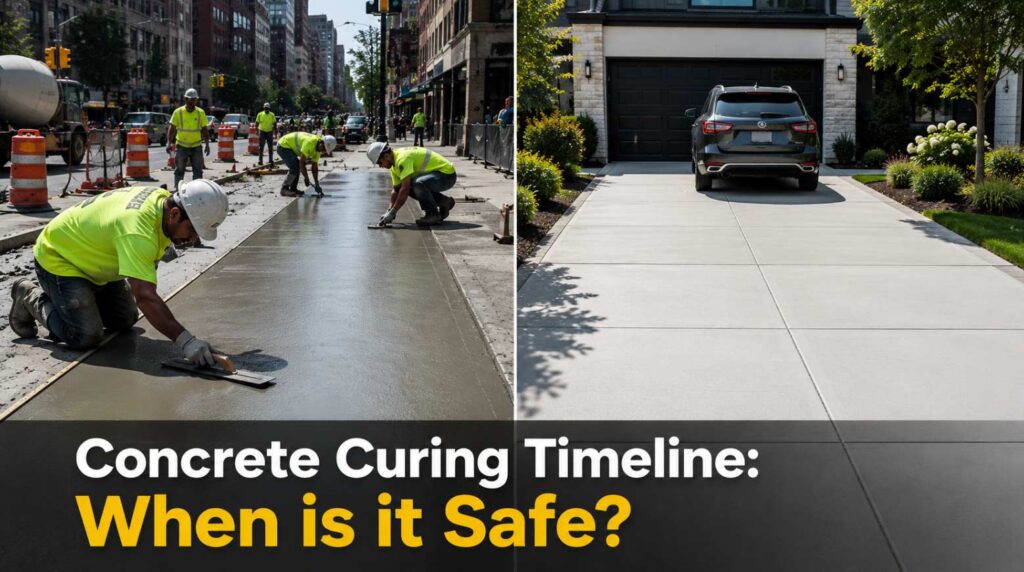
Property owners routinely ask: how long does it take for concrete to dry? Concrete typically dries enough for foot traffic within 24 to 48 hours. However, it takes seven days to cure sufficiently for standard vehicles and 28 days to reach its full compressive strength. Proper curing practices ensure lasting durability.
Waiting the appropriate amount of time before utilizing a newly poured surface prevents cracking, rutting, and structural failure. Planning an exact concrete installation timeline requires understanding the chemical processes occurring beneath the surface.
Understanding Concrete Drying Time vs. Concrete Curing Time
Many people use the terms drying and curing interchangeably. These are distinct processes in construction material science. Understanding the difference prevents premature use of new slabs, foundations, and driveways.
The Chemical Reality: Hydration
Concrete drying refers to the physical evaporation of surface moisture. This happens relatively quickly depending on ambient humidity and sunlight. The surface may appear light gray and solid within a single day.
The concrete curing time refers to a chemical reaction called hydration. When water mixes with Portland cement, microscopic crystals grow and interlock. This interlocking creates the rigid, dense structure required for load-bearing capacity. Hydration requires continuous moisture. If the concrete dries too rapidly, hydration stops prematurely. This results in weak, brittle concrete prone to surface scaling and deep structural cracks.
The Standard Concrete Strength Timeline
The concrete curing process follows a standardized trajectory. Structural engineers and contractors rely on this timeline to schedule construction phases safely.
24 to 48 Hours: Initial Set
During the first 24 to 48 hours, the concrete achieves its initial set. The mix transitions from a plastic, workable state to a rigid solid. The surface hardens enough to support light, dispersed weight. Forms are typically removed during this window.
7 Days: Partial Strength
At the seven-day mark, concrete typically reaches 70 percent of its intended design strength. Hydration occurs most rapidly during this first week. The structure can now handle heavier loads without immediate surface deformation. This stage is critical for a standard concrete driveway curing time.
28 Days: Full Compressive Strength
Industry standards dictate that concrete reaches its full compressive strength at 28 days. While microscopic hydration continues for years, the 28-day mark is the benchmark for structural testing. Engineers conduct cylinder crush tests at this exact date to verify the concrete meets DOB code compliance and safety requirements.
Concrete Strength Timeline Table
| Time Elapsed | Strength Percentage | Permitted Activity |
| 24 to 48 Hours | 15% to 20% | Form removal, light foot traffic. |
| 7 Days | 70% to 75% | Standard passenger vehicle parking. |
| 28 Days | 100% (Design Strength) | Heavy machinery, commercial trucks, full load bearing. |
Traffic Guidelines: When Is It Safe to Use?
Knowing exactly when to load a new surface protects your investment. Premature loading fractures the internal crystal structures formed during early hydration.
When Can You Walk on Concrete?
You can safely walk on new concrete 24 to 48 hours after the pour. It is necessary to keep pets, bicycles, and heavy equipment off the surface during this time. Footwear should be flat. Sharp heels or work boots with aggressive treads can mar the surface if the concrete retains excess moisture.
For a standard concrete sidewalk curing time, municipal contractors mandate keeping pedestrians blocked off for at least a full day to ensure a pristine finish.
When Can You Drive on Concrete?
You must wait a minimum of seven days before driving a standard passenger car on a new driveway. The weight of a standard vehicle requires the concrete to reach its 70 percent strength threshold.
For heavy-duty vehicles, commercial trucks, or RVs, you must wait the full 28 days. Driving heavy loads on partially cured concrete causes micro-fractures in the sub-base and the concrete slab itself. These fractures expand over time due to freeze-thaw cycles.
How Weather Affects Concrete Curing
Environmental conditions directly dictate new concrete drying time. Ideal curing conditions feature temperatures between 50 and 70 degrees Fahrenheit with moderate humidity. Extreme weather disrupts the hydration process.
Temperature Variations in NYC
Understanding how weather affects concrete curing is mandatory for Concrete Contractor in NYC. The region experiences extreme summer heat and severe winter freezes.
During hot summer pours in Brooklyn or Queens, high temperatures accelerate surface evaporation. Rapid evaporation causes shrinkage cracks. Contractors combat this by applying curing compounds, spraying the surface with water, or scheduling early morning pours.
Winter installations in Manhattan or Long Island present different challenges. If the water inside the concrete mix freezes before hydration completes, the concrete loses up to 50 percent of its potential strength. Construction teams utilize heated enclosures, thermal curing blankets, and warm water mixes to maintain the required internal temperature.
Humidity and Moisture Retention
High humidity aids the hydration process by slowing surface evaporation. Proper moisture retention is the most vital aspect of curing. Contractors utilize wet curing methods to trap moisture. This involves covering the slab with plastic sheeting, wet burlap, or specialized curing membranes. Continuous moisture retention during the first seven days guarantees a dense, durable surface resistant to wear and tear.
Factors Impacting New Concrete Drying Time
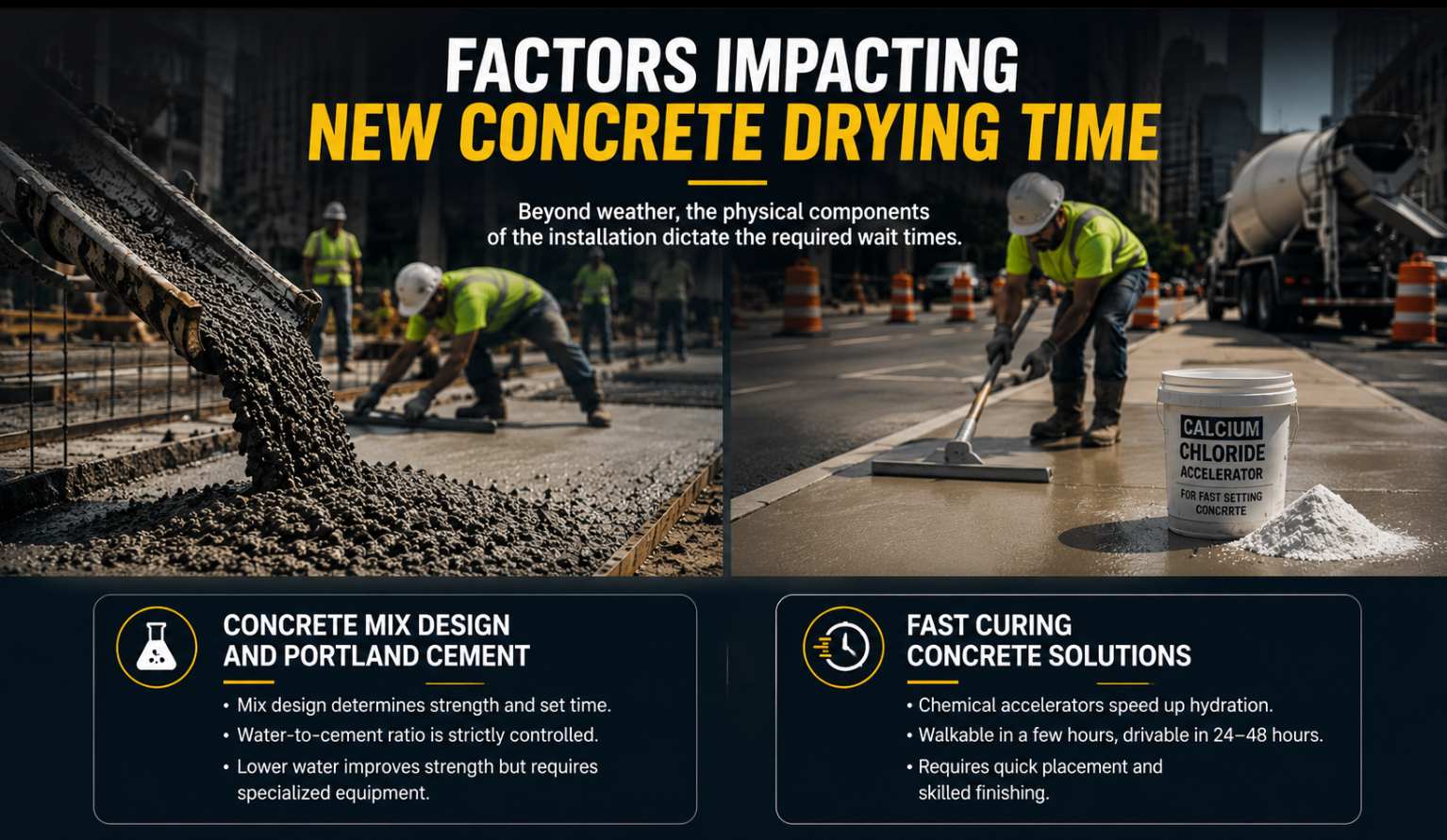
Beyond weather, the physical components of the installation dictate the required wait times.
Concrete Mix Design and Portland Cement
The specific concrete mix design determines both strength and set time. A higher ratio of Portland cement generally yields a stronger final product but requires precise water management. The water-to-cement ratio is strictly controlled. Too much water makes the concrete easier to pour but weakens the final structure. A lower water-to-cement ratio produces stronger concrete but requires specialized equipment and vibration tools for proper placement.
Fast Curing Concrete Solutions
Certain projects require accelerated timelines. Municipal repairs or active commercial zones cannot wait a full week for traffic restoration. In these instances, contractors utilize fast curing concrete.
These specialized mixes contain chemical accelerators, such as calcium chloride. Accelerators speed up the hydration reaction. A fast-setting mix can achieve walkable strength in just a few hours and drivable strength in 24 to 48 hours. However, these mixes require rapid placement and finishing by experienced professionals before the material hardens in the equipment.
Professional Concrete Installation Practices
Commercial properties and large residential developments require strict adherence to structural engineering guidelines. As a premier Construction Company In NYC, proper site preparation and curing management ensure longevity and code compliance.
The Role of Expansion Joints and Reinforcement
Concrete expands and contracts with temperature fluctuations. Professional installations incorporate expansion joints at strategic intervals. These joints provide a controlled space for the concrete to move, preventing random, jagged cracks across the slab.
Additionally, internal reinforcement dictates the slab’s load-bearing capacity. Steel rebar grids or welded wire mesh provide tensile strength. While concrete is highly resistant to compressive forces (pushing down), it is weak against tensile forces (pulling apart). The reinforcement works in tandem with proper concrete curing to prevent structural failure under heavy loads.
If you are planning a large-scale pour, working with a dedicated Construction Company In The Bronx ensures these technical elements are handled correctly from excavation to final cure.
Conclusion and Next Steps
The answer to the concrete curing timeline is rooted in chemistry and environmental management. Wait 24 to 48 hours for foot traffic, seven days for passenger vehicles, and 28 days for maximum structural capacity. Monitoring the weather, utilizing proper moisture retention techniques, and selecting the correct mix design guarantees a flawless finish.
Attempting to rush the curing phase guarantees future expenses in repairs and replacements. For guaranteed results, competitive vendor bidding, and seamless execution with minimal disruption, trust a fully licensed and insured team.
To discuss your next project with Alliance General Construction Corp, Contact Us / Free Quote today. Our team manages the end-to-end process, ensuring strict DOB code compliance and lasting results.
Frequently Asked Questions
How long does it take for concrete to dry?
Concrete dries enough for safe foot traffic in 24 to 48 hours. It takes 28 days for the concrete to cure entirely and reach its peak structural strength.
When can you walk on concrete?
You can walk on newly poured concrete after 24 to 48 hours. Ensure you use flat-soled shoes and keep pets away to avoid scuffing the fresh surface.
When can you drive on concrete?
Standard passenger cars can drive on new concrete after seven days. Heavy trucks and commercial machinery must wait the full 28-day curing period.
How does weather affect concrete curing?
Hot weather accelerates surface evaporation and causes shrinkage cracks, while freezing temperatures can halt the hydration process entirely. Optimal curing requires moderate temperatures and consistent moisture retention.
What is fast curing concrete?
Fast curing concrete utilizes chemical accelerators to drastically reduce the initial set time. This specialized mix allows for foot traffic in a few hours and vehicle traffic in a day or two.