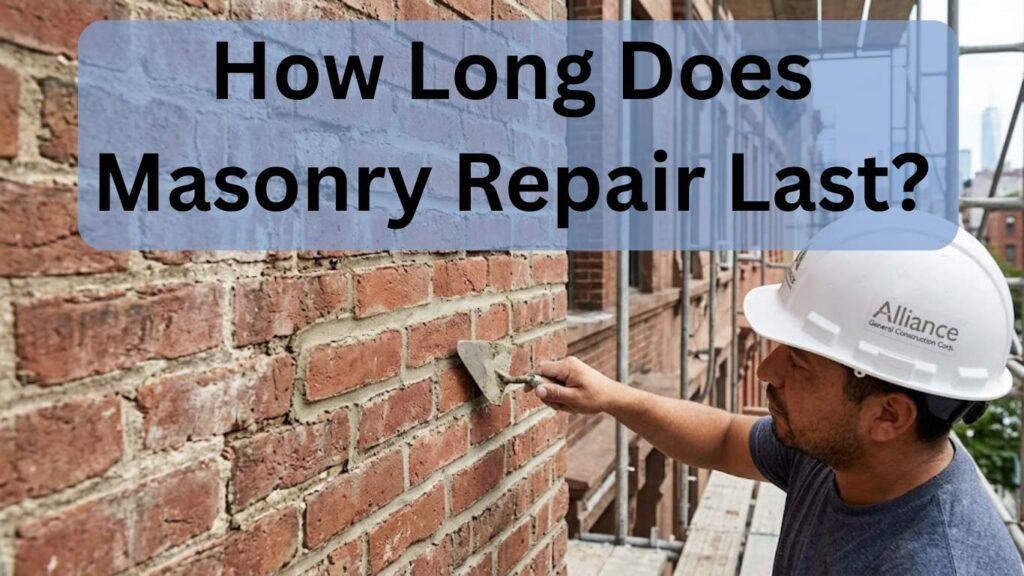
How long does masonry repair last? A professional masonry repair lasts between 20 and 50 years depending on the material and environmental exposure. In New York City, harsh freeze-thaw cycles reduce mortar lifespan to the lower end of that range, making proper installation and code-compliant materials critical for long-term structural integrity.
What Does Masonry Repair Actually Involve?
Masonry repair addresses degraded brick, stone, and mortar to restore structural stability and water resistance. The process typically involves repointing by replacing degraded mortar joints, executing selective brick replacement, and applying waterproof masonry coatings. This prevents water infiltration, maintains DOB compliance, and preserves the building facade against harsh weather conditions.
Property managers and real estate investors must view masonry maintenance as a necessary capital expenditure. Ignoring degraded masonry leads to interior water damage, tenant disruption, and severe Department of Buildings violations. Understanding the masonry repair lifespan helps owners budget accurately and secure reliable masonry contractors for the job.
Average Lifespan of Different Masonry Repairs
The lifespan of a masonry repair depends entirely on the specific materials used, the structural application, and the quality of the initial workmanship. Commercial building owners need to know these baseline timelines to project future maintenance cycles and avoid unexpected facade failures.
Over our 10+ years managing NYC properties, we have observed that material choice directly dictates longevity. For example, using Portland cement on historic, soft brick creates rigid joints that crack the brick face over time. Proper mortar matching is essential for maximizing the tuckpointing lifespan.
| Material / Repair Type | Average Lifespan (Years) | Key Influencing Factors |
| Tuckpointing / Repointing | 20 to 30 Years | Mortar type used (Type N vs. Type S), exposure to driving rain, and quality of mortar joint tooling. |
| Brick Replacement | 50 to 100+ Years | Density of the replacement brick, quality of surrounding mortar, and presence of functional weeping joints. |
| Stone Masonry Repair | 40 to 80 Years | Type of stone (limestone vs. granite), structural load, and proper installation of flashing. |
| Concrete Block Repair | 30 to 50 Years | Waterproofing treatments, foundation settlement, and protection from ground moisture. |
| Chimney Masonry Repair | 15 to 25 Years | High exposure to wind, corrosive exhaust gases, and rooftop freeze-thaw cycles. |
To achieve maximum brick pointing longevity, contractors must remove old mortar to a depth of at least three-quarters of an inch. Cutting corners during the removal phase guarantees a premature failure of the new mortar.
What Causes Masonry to Fail Early in NYC?
Masonry repair fails early in New York City due to environmental extremes, improper material selection, and uncoordinated trade work. A successful masonry restoration requires a deep understanding of local building codes and climate realities.
The Freeze-Thaw Cycle
Water expands by nine percent when it freezes. When a masonry contractor NYC does not properly seal mortar joints, water penetrates the brick wall. During winter, this trapped moisture freezes and expands. This hydraulic pressure shatters brick faces and pushes mortar out of the joints. Navigating harsh NYC freeze-thaw cycles is the primary challenge for any exterior building maintenance.
Poor Initial Workmanship and Incorrect Materials
Unlicensed or inexperienced contractors often use incorrect mortar blends. For structural masonry repair on load-bearing walls, high-compressive-strength Type S mortar is necessary. However, applying Type S mortar to a historic Brooklyn brownstone will destroy the softer original brick. Mismatched materials restrict thermal expansion and cause rapid joint failure.
Water Infiltration and Blocked Weep Holes
Modern brick facades are cavity walls designed to manage water. Moisture that penetrates the brick is supposed to drain down the internal cavity and exit through weeping joints at the base. Poor workmanship from past uncoordinated trades often leaves these cavities clogged with excess mortar. Blocked cavities trap water inside the structure, leading to accelerated masonry deterioration and interior leaks.
Building Settlement and Vibrations
New York City is a dense, high-vibration environment. Heavy subway traffic, adjacent excavation, and natural soil consolidation cause buildings to settle. This movement places immense shear stress on rigid brick walls. Without proper expansion joints installed during the initial facade restoration NYC, the resulting stress fractures both the bricks and the mortar joints.
5 Signs Your Masonry Repair is Failing
Failing masonry presents clear visual cues before a catastrophic structural event occurs. Property owners must conduct routine visual inspections to identify signs masonry repair is failing early.
- Spalling Bricks: The surface of the brick flakes, peels, or pops off entirely. This indicates severe moisture penetration and freeze-thaw damage. Spalling compromises the structural integrity of the wall and requires immediate brick replacement.
- Efflorescence: A white, powdery residue appears on the surface of the brick. This happens when water travels through the masonry, dissolving natural salts and leaving them on the surface as the water evaporates. While efflorescence itself is a cosmetic issue, it is a definitive sign of active water infiltration.
- Cracking Mortar Joints: Hairline cracks or missing chunks of mortar compromise the building envelope. Stair-step cracks along the mortar lines typically indicate building settlement or foundation movement.
- Bulging or Bowing Walls: If a brick wall appears to lean or bulge outward, the structural masonry ties connecting the brick veneer to the building frame have failed. This is a severe safety hazard that triggers immediate DOB violations.
- Interior Water Leaks: Moisture staining on interior drywall or plaster directly behind a brick facade means the exterior masonry barrier has completely failed.
The Alliance “Team-Built” Advantage for Masonry Restoration
Extending your Masonry repair lifespan requires a coordinated, code-compliant approach. When bringing a Bronx commercial facade up to DOB code, disjointed subcontractor management inevitably leads to poor quality control and early mortar failure.
Alliance General Construction Corp eliminates this risk through our proprietary Team-Built approach. We provide end-to-end project management with a single point of contact. This ensures that every phase of your masonry restoration aligns perfectly with strict NYC building codes. We handle all Local Law 11 / FISP (Facade Inspection & Safety Program) compliance requirements. This protects property owners from fines and legal liability.
Furthermore, our competitive vendor bidding process guarantees that we source high-quality, long-lasting materials at the best possible price. By tightly managing specialized trades under one roof, we execute seamless repairs with minimal disruption to owners and tenants.
Whether you need routine brick repair NYC or a massive commercial facade overhaul, our licensed and insured team delivers structural integrity you can trust. Explore our comprehensive General Contracting Services to see how we protect real estate assets across all five boroughs.
Frequently Asked Questions
How often should brick be repointed?
Brick should be repointed every 20 to 30 years. However, high-exposure areas like chimneys and parapet walls may require repointing every 15 years due to severe weather exposure. Routine inspections help identify degrading mortar joints before they cause interior water damage.
Do I need a DOB permit for masonry repair in NYC?
Yes. Most structural Masonry Repairs and exterior facade work in New York City require a permit from the Department of Buildings. Minor cosmetic patching under a certain square footage may be exempt, but any work involving scaffolding, Local Law 11 compliance, or structural alteration mandates official DOB approval.
What is the difference between tuckpointing and repointing?
Repointing is the process of removing damaged mortar and replacing it with new mortar. Tuckpointing involves replacing the mortar and then applying a contrasting thin line of putty down the center of the new joint to create the visual illusion of perfectly straight, narrow bricks.
Can a contractor perform masonry repair in the winter?
Yes, but it requires specialized equipment. Mortar must remain above 40 degrees Fahrenheit to cure properly. A professional masonry restoration contractor will use heated enclosures and warm water mixes to ensure winter repairs achieve maximum structural strength.
Does waterproofing spray protect brick walls?
Silane-siloxane penetrating sealers can help create waterproof masonry by repelling liquid water while still allowing water vapor to escape. Film-forming sealers should never be used on brick because they trap moisture inside the wall, accelerating freeze-thaw damage and brick spalling.
Secure Your Property’s Structural Integrity
Understanding the masonry repair lifespan is just the first step in responsible property management. Ignoring cracking mortar or spalling brick inevitably leads to higher recurring maintenance costs, dangerous structural failures, and severe DOB penalties. Proactive maintenance protects your investment, ensures tenant safety, and preserves the value of your asset.
Do not wait for a facade violation to address your building’s exterior. Trust a fully licensed and insured general contracting firm with over a decade of NYC experience. Contact Alliance General Construction Corp today to schedule a comprehensive structural inspection and secure your Free Consultation. Let our Team-Built approach deliver a seamless, code-compliant masonry restoration.