Concrete contractors need working capital because materials, labor, and equipment all have to be paid for weeks — sometimes months — before the client’s payment arrives. Without enough cash on hand, even a fully booked, profitable contractor can stall out mid-project. Working capital is what keeps payroll running, trucks on the road, and concrete trucks showing up on schedule while invoices are still working their way through approval.
At Alliance General Construction Corp, we’ve managed general and concrete contracting projects across the Bronx, Queens, Brooklyn, Manhattan, and Long Island for more than 10 years. We’ve seen firsthand how a cash flow gap — not a lack of skill or work — is usually what turns a good project into a delayed one.
What Working Capital Actually Means for a Concrete Contractor
Working capital is simply the cash a business has on hand to cover its day-to-day operating expenses — payroll, materials, fuel, insurance, rent — separate from its long-term assets or overall revenue. It’s easy to confuse working capital with profit, but they aren’t the same thing.
A contractor can land a $200,000 concrete job that’s profitable on paper and still run short on cash, because the cost of materials and labor hits the bank account long before the client’s payment does. That gap between spending and getting paid is exactly what working capital is meant to cover.
Where the Cash Goes: The Real Costs Behind Every Concrete Pour
Weekly Payroll
Concrete crews, laborers, and equipment operators expect to be paid weekly, regardless of when the general contractor or property owner pays their invoice. On a multi-week foundation or slab job, payroll alone can add up to tens of thousands of dollars before the first progress payment ever arrives.
Material Procurement
Concrete, rebar, forms, and reinforcement materials often require payment up front or on tight supplier terms — sometimes before the material even reaches the jobsite. Price swings in materials only add pressure, since a bid priced months earlier may no longer match today’s cost.
Equipment Rental
Pumps, mixers, and heavy equipment for larger commercial or municipal pours are frequently rented by the day or week. Rental costs don’t pause for a slow-paying client, and equipment coordination has to be planned around the project schedule, not around when cash happens to be available.
Key takeaway: By the time a concrete crew finishes a pour, a contractor has usually already spent on payroll, materials, and equipment — all before collecting a dollar from the client.
Why Payment Delays Hit Concrete Projects Especially Hard
Construction has some of the longest payment cycles of any industry, and concrete work is no exception. Industry research from Dodge Construction Network found that a large majority of construction companies experienced moderate-to-severe cash flow challenges in recent years, with payment delays as the leading cause. Separate industry surveys have found that a significant share of subcontractors say they don’t have enough working capital to absorb an unexpected expense or a delayed payment.
Progress Payments and Retainage
Most concrete and construction contracts are paid in progress payments tied to project milestones, with a percentage — typically 5–10% — withheld as retainage until the entire project is complete. That retainage can represent thousands of dollars in earned-but-unpaid work sitting on the sidelines for months, even after the contractor’s own costs have already been paid out.
Key takeaway: Retainage and 30-60+ day payment cycles are standard in construction — which means a contractor’s cash has to stretch further than the payment terms suggest.
What Happens When Working Capital Runs Short
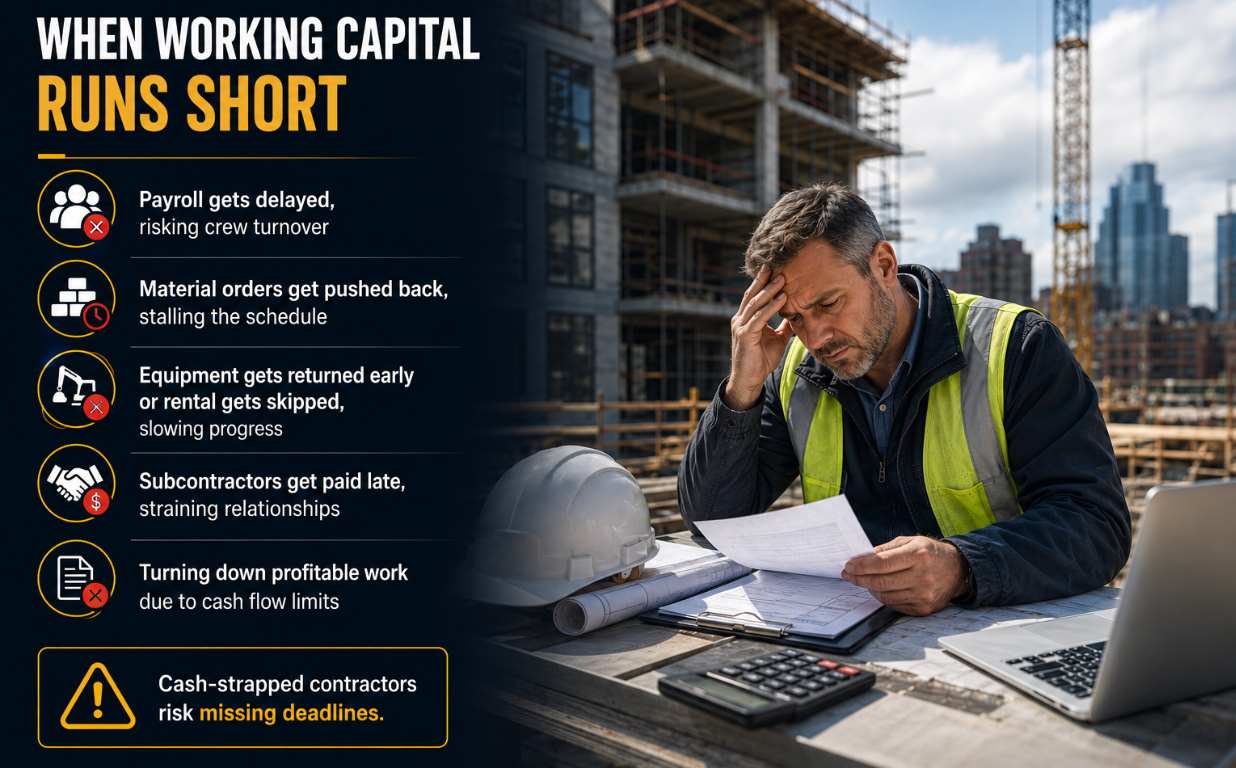
When a contractor doesn’t have enough working capital, the effects show up fast:
- Payroll gets delayed, risking crew turnover on an active job
- Material orders get pushed back, stalling the schedule
- Equipment gets returned early or rental gets skipped, slowing progress
- Subcontractors get paid late, straining relationships needed on future bids
- The contractor has to turn down new, profitable work simply because they can’t front the costs
For a property owner or developer, this is the practical reason working capital matters even if it’s “the contractor’s problem” — a cash-strapped contractor is a contractor at risk of missing deadlines.
A Real-World Look at Contractor Payment Delays in NYC
Consider a standard multi-family foundation project located in Queens or Brooklyn. Contractor payment delays are rarely malicious. They are simply a byproduct of institutional red tape. A contractor completes the foundation pour on day 15 of the month. They submit an invoice on day 30. The architect takes seven days to inspect the work and approve the draw. The developer’s bank takes another 15 days to release the funds.
By the time the contractor receives the check, 45 to 60 days have passed since they initially paid the ready-mix supplier and their laborers.
Financing Options That Keep Cash Flow Healthy
Contractors typically use one or more of these tools to bridge the gap between spending and getting paid:
| Financing Tool | What It’s Best For |
| Business line of credit | Ongoing, flexible access to cash for payroll and materials |
| Construction/project financing | Funding a specific large project separately from general operations |
| Equipment financing | Spreading out the cost of owned equipment instead of paying cash up front |
| Invoice/accounts receivable financing | Getting paid sooner against outstanding invoices |
| Cash reserve (self-funded) | A dedicated buffer, often targeted around 10% of annual revenue, for predictable gaps |
No single tool fits every contractor. The right mix depends on project size, how quickly clients typically pay, and how much of the business’s revenue comes from milestone-based construction contracts versus faster-turnaround work.
This section is general financial education based on common industry practices — it isn’t formal financial or lending advice, and contractors should consult a qualified financial advisor before choosing a financing strategy.
How Alliance General Construction Corp Manages Cash Flow Across Every Project
As a General contractor in NYC, Alliance General Construction Corp builds working capital planning into every project from day one. Our Team-Built approach includes competitive vendor bidding to control material costs, strict DOB code compliance to avoid costly rework, and single point-of-contact project management so payment schedules, material orders, and crew payroll all stay coordinated instead of colliding.
This financial discipline is part of why we can take on everything from a residential driveway pour to a full commercial construction slab without the project stalling because of a cash flow gap on our end. Whether the job is in the Bronx, Queens, Brooklyn, Manhattan, or Long Island, our clients get a contractor whose finances are as stable as the concrete we pour.
Secure Your Next Concrete Project
Financial stability dictates structural quality. You need a contracting partner with the resources, experience, and municipal expertise to handle the harsh realities of NYC construction.
Whether you are planning a commercial foundation, an industrial slab, or a multi-family structural repair, our team is equipped to manage the entire process smoothly from initial DOB permitting to final sign-off.
Contact Us / Free Quote Today or Call (347) 515-8989 to discuss your next structural project with our expert team.
FAQs About Why Concrete Contractors Need Working Capital
What is working capital in construction, in simple terms?
Working capital is the cash a contractor has available to cover day-to-day costs like payroll, materials, and rentals — separate from profit or total contract value.
Why do concrete contractors specifically need more working capital than other trades?
Concrete work requires large up-front material orders, heavy equipment rental, and steady payroll, all of which are typically paid out well before client progress payments arrive.
What happens if a contractor runs out of working capital mid-project?
Payroll, material orders, and equipment rentals can get delayed, which slows the project schedule and can strain relationships with crews and subcontractors.
What financing options help contractors manage cash flow?
Common tools include a business line of credit, construction/project financing, equipment financing, and invoice or accounts receivable financing.
How much working capital should a construction business keep on hand?
Many industry benchmarks suggest a reserve of roughly 10% of annual revenue as a starting point, though the right amount depends on how quickly a contractor’s clients typically pay.